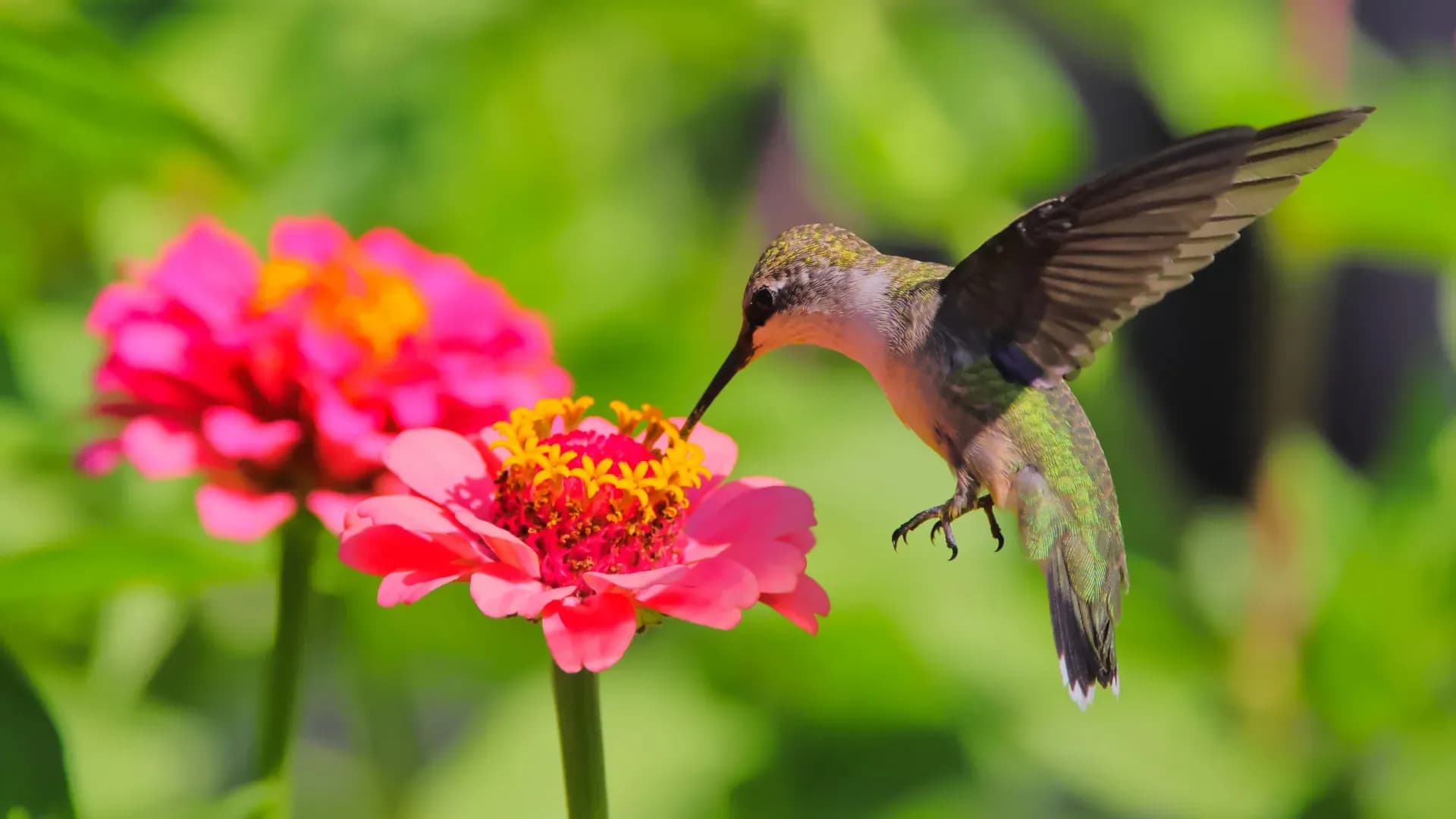
Bees and Hummingbirds Are Consuming Alcohol Every Day — And Science Has Finally Noticed
New research reveals that flower nectar contains measurable amounts of ethanol, meaning pollinators are essentially drinking alcohol all day — without showing any signs of intoxication.

The Secret Ingredient in Every Flower
When a hummingbird darts between blooms or a bee lands on a flower to gather nectar, most of us picture a simple exchange — pollinator feeds, plant reproduces. But a groundbreaking new study from the University of California, Berkeley has revealed something far more surprising hidden inside that nectar: alcohol.
In what is believed to be the first comprehensive survey of ethanol content in floral nectar, UC Berkeley biologists tested 29 plant species and detected measurable levels of ethanol in at least one sample from 26 of them. The findings were published on March 25 in the journal Royal Society Open Science.
How Alcohol Ends Up in Nectar
The ethanol found in flower nectar is not added artificially — it forms naturally. Yeast present in the nectar ferments the sugars over time, producing small quantities of alcohol as a byproduct. Most of the samples contained only trace concentrations, though one sample reached 0.056% ethanol by weight, roughly equivalent to one-tenth of a proof rating.
While that figure might seem negligible, the story changes dramatically when you factor in just how much nectar certain animals consume each day.
Hummingbirds Are Drinking the Human Equivalent of a Daily Cocktail
Hummingbirds are among the most voracious nectar consumers in the animal kingdom. Depending on the species and season, they can drink anywhere from 50% to 150% of their own body weight in nectar every single day.
Using those feeding rates, the research team calculated that an Anna's hummingbird — a species commonly spotted along the Pacific coast of North America — ingests approximately 0.2 grams of ethanol per kilogram of body weight daily. To put that in perspective, that is roughly equivalent to a human consuming one standard alcoholic drink per day.
Despite this ongoing exposure, neither hummingbirds nor bees display any visible signs of intoxication. Researchers believe this is largely because the alcohol is consumed gradually throughout the day in small sips, rather than all at once.
A Tiny Furnace That Burns Everything Fast
"Hummingbirds are like little furnaces. They burn through everything really quick, so you don't expect anything to accumulate in their bloodstream," said Aleksey Maro, a doctoral student involved in the nectar analysis. "But we don't know what kind of signaling or appetitive properties the alcohol has. There are other things that the ethanol could be doing aside from creating a buzz, like with humans."
Robert Dudley, UC Berkeley professor of integrative biology and a lead researcher on the project, echoed that sentiment. "They're burning it so fast, I'm guessing that they probably aren't suffering inebriating effects. But it may also have other consequences for their behavior," he said.
Hummingbirds Know Their Limits
Interestingly, earlier experiments conducted at a feeder outside Dudley's own office revealed that Anna's hummingbirds are remarkably good at self-regulating their alcohol intake. When sugar water at the feeder contained less than 1% alcohol by volume, the birds showed little to no aversion. However, once concentrations climbed to 2%, the hummingbirds visited the feeder roughly half as often.
"Somehow they are metering their intake, so maybe zero to 1% is a more likely concentration that they would find in the wild than anything higher," Dudley noted.
This behavioral threshold suggests the birds may have developed an intuitive awareness of safe ethanol levels — a possible sign of evolutionary adaptation to their nectar-rich diet.
The Evidence Goes Beyond Behavior
The case for alcohol tolerance in hummingbirds doesn't rest on behavioral observations alone. A separate study led by former graduate student Cynthia Wang-Claypool discovered that hummingbird feathers — including those of Anna's hummingbirds — contain ethyl glucuronide, a compound produced when the body metabolizes ethanol. This is the same metabolic pathway seen in mammals, including humans.
Taken together, the behavioral studies, the feather analysis, and this new nectar survey paint a consistent picture: hummingbirds regularly consume alcohol, metabolize it efficiently, and appear to have biological systems in place to handle it.
Comparing Alcohol Intake Across Species
To provide broader context, the researchers compared daily ethanol consumption across several species:
- Pen-tailed tree shrew — the highest intake at 1.4 g/kg/day
- Anna's hummingbird and sunbirds — approximately 0.19 to 0.27 g/kg/day from natural nectar
- Humans consuming one standard drink — roughly 0.14 g/kg/day
- European honeybee — the lowest intake at just 0.05 g/kg/day
Notably, when hummingbirds feed from fermented sugar water in backyard feeders rather than wild flowers, their estimated alcohol intake can rise slightly higher, to around 0.30 g/kg/day.
Sunbirds, the African ecological counterpart to hummingbirds, were also included in the analysis. These birds feed on plants such as honeybush (Melianthus major) in South Africa and showed comparable ethanol intake to their American relatives.
A Window Into Evolutionary Adaptation
This research forms part of a larger five-year project funded by the National Science Foundation, which aims to collect genetic data from hummingbirds and sunbirds to better understand how these animals adapt to extreme environments and specialized diets — including high-altitude living, sugar-heavy nutrition, and chronic exposure to fermented nectar.
"These studies suggest that there may be a broad range of physiological adaptations across the animal kingdom to the ubiquity of dietary ethanol, and that the responses we see in humans may not be representative of all primates or of all animals generally," said Dudley.
He went on to suggest that animals consuming ethanol on a daily basis throughout their lives may have developed unique detoxification pathways or may even derive nutritional benefit from the compound in ways science has yet to fully understand.
"It just means that the comparative biology of ethanol ingestion deserves further study," he added.
What This Means for Our Understanding of Nature
Far from being an oddity, alcohol consumption in the natural world may be far more widespread and biologically significant than previously recognized. The fact that pollinators have potentially co-evolved alongside fermented nectar for millions of years raises compelling questions about how alcohol has shaped animal physiology — and whether the human relationship with alcohol is part of a much older, much broader evolutionary story.

