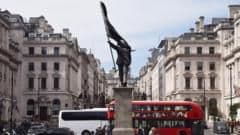
Banksy Unveils Striking New London Statue Depicting a Flag-Blinded Figure in a Suit
The elusive street artist Banksy has confirmed his latest work — a large resin statue installed covertly in the heart of London's ceremonial Waterloo Place.

Banksy Claims New Central London Statue That's Stopping Crowds in Their Tracks
Mysterious street artist Banksy has officially confirmed that a bold new sculpture which materialized in central London this week is indeed his creation. The large-scale piece, located on a ceremonial island in Waterloo Place, St James's, depicts a formally dressed man in a suit stepping forward off a plinth while clutching a flag that entirely obscures his face — leaving him moments away from a symbolic fall.
A Powerful Statement in a Historic Setting
The choice of location is far from accidental. Waterloo Place is steeped in the legacy of British imperialism and military might, having been designed in the 19th century as a showcase of national power and dominance. The new sculpture now stands in close proximity to statues of Edward VII, Florence Nightingale, and the Crimean War Memorial — making its commentary all the more pointed.
Banksy's team confirmed to the BBC that the piece was installed covertly in the early hours of Wednesday morning. The artist later posted footage of the statue on his Instagram account on Thursday afternoon, adding a characteristically dry note about its placement: "There was a bit of a gap."
Public Reaction: Crowds Flock to See the Work
Since the sculpture appeared, growing numbers of curious onlookers have been making their way to Waterloo Place to see it in person. Among them was 23-year-old student Ollie Isaac, who described the experience as a must-see moment.
"With Banksy, it's a limited time event because it's public art — you don't know how long it's going to be up," he said. He interpreted the work as a direct response to "the resurgence of nationalism in the world and this country," adding: "That suit screams politician."
Teacher Lynette Cloraleigh, 55, learned about the statue through a friend's Instagram post and made her way there shortly after. "I like it," she said. "I like where it is. It's intriguing how it got here."
City Council's Response
Westminster City Council, which oversees the area, responded positively to the unexpected addition. In a statement, the council said: "We're excited to see Banksy's latest sculpture in Westminster, making a striking addition to the city's vibrant public art scene. While we have taken initial steps to protect the statue, at this time it will remain accessible for the public to view and enjoy." Safety barriers were also erected around the work on Thursday afternoon.
Expert Analysis: A Masterclass in Artistic Timing
James Peak, creator of the BBC podcast series The Banksy Story, praised the work as another triumphant maneuver from the elusive artist.
"Here, you've got a brilliant comment on a bumptious, chest-puffed-out man in power with the flag completely obscuring his vision, which is why he is about to fall off the plinth," Peak explained. "It is a wonderfully framed moment in time that you never really get with a statue."
Peak also marveled at the logistical feat involved in installing such a large piece without detection. "I don't know how he's managed to do it. How has he got a low-loader there with all the security and put up a massive resin statue?"
He further noted the deeper historical resonance of the location: "We've got to face up to the fact that Britain has an imperialistic history full of takeovers, and part of that is the sort of extreme nationalism that Banksy absolutely abhors."
Online Reaction
Fans on Instagram were quick to share their interpretations. One commenter wrote: "I love that he appears when enough time has passed to forget, and arrives with full force unnoticed." Another noted: "As a long-time Banksy collector, this one really hits. Big monument energy, but the idea is brutally simple: a suited figure blinded by its own flag. Classic Banksy. Quiet at first, then impossible to unsee."
The prevailing interpretation among viewers is that the statue serves as a sharp commentary on blind patriotism and the dangers of nationalism unchecked by perspective.
Part of a Broader London Series
This is not the first time Banksy has left a sculptural mark on London's streets. In 2004, The Drinker — a subversive reimagining of Rodin's The Thinker — appeared on Shaftesbury Avenue before being stolen shortly after its installation.
The Waterloo Place statue is the latest in a recent and prolific run of London-based works. In December, a mural appeared in Bayswater depicting two children lying on the ground. In September, a scene was painted on the Royal Courts of Justice showing a protester on the ground holding a blood-spattered placard while a judge loomed overhead, gavel in hand.
Throughout 2024, Banksy created an animal trail across the capital, featuring pieces including a goat, elephants, a gorilla, monkeys, piranhas, a rhinoceros, and pelicans.
In keeping with his established pattern, each work appears covertly on both public and private property, is later confirmed via Instagram, and is widely read as a political statement. Many are removed not long after they surface — making each sighting a fleeting, time-sensitive cultural event.