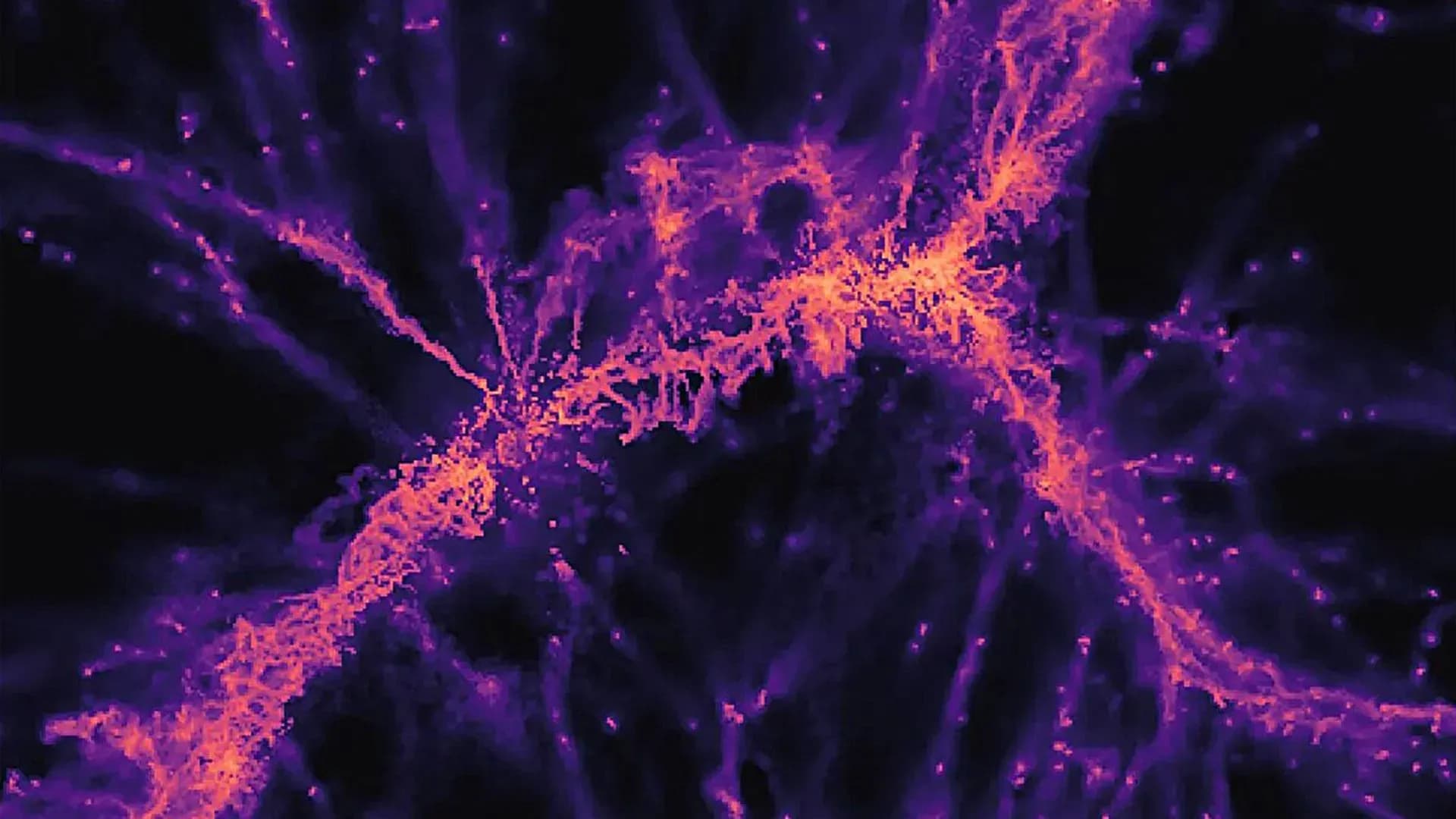
Astronomers Capture the Sharpest-Ever Image of the Universe's Cosmic Web
For the first time, scientists have directly imaged a 3-million-light-year cosmic filament, revealing the hidden highways that connect galaxies across the Universe.

A Hidden Universe Finally Comes Into Focus
For decades, the cosmic web has existed largely in theory — an invisible, sprawling network of matter that silently connects galaxies across the vastness of space. Now, for the first time, astronomers have captured the sharpest direct image ever taken of one of its colossal filaments, pulling back the curtain on a structure that has shaped the Universe for billions of years.
The glowing strand of intergalactic gas stretches an astonishing 3 million light-years and links two galaxies that were actively forming stars when the Universe was barely 2 billion years old — nearly 12 billion years in the past. The achievement marks a major turning point in our understanding of how galaxies are born, fed, and sustained over cosmic time.
What Is the Cosmic Web?
Modern cosmology paints a striking picture of the Universe's large-scale architecture. Dark matter, which accounts for approximately 85% of all matter in existence, is thought to form an immense web-like skeleton composed of long, thread-like filaments. Where these filaments cross, gravity pulls ordinary matter together, giving rise to the brilliant galaxies we observe today.
Beyond simply connecting galaxies, these filaments are believed to serve as intergalactic highways — vast channels through which hydrogen gas flows directly into galaxies, igniting the formation of new stars. Understanding exactly how this gas travels and accumulates is considered one of the most important questions in modern astrophysics.
Why Has This Been So Difficult to Observe?
Despite their central role in cosmic evolution, filaments of the cosmic web have remained frustratingly difficult to detect. Hydrogen, the most abundant element in the Universe, emits only an extremely faint glow. Until recently, most of what scientists knew about intergalactic gas came from indirect measurements — studying how the gas absorbs light from bright background sources rather than observing it directly. The sheer faintness of these structures pushed older instruments well beyond their limits.
Hundreds of Hours Behind the Telescope
The breakthrough came from an international collaboration between researchers at the University of Milano-Bicocca and the Max Planck Institute for Astrophysics (MPA). The team turned to MUSE — the Multi-Unit Spectroscopic Explorer — a highly advanced instrument mounted on the European Southern Observatory's Very Large Telescope, perched high in the Chilean Atacama Desert.
Even with such cutting-edge equipment at their disposal, capturing this elusive structure demanded an extraordinary commitment of time. The researchers conducted one of the most extensive MUSE observation campaigns ever focused on a single patch of sky, accumulating hundreds of hours of telescope data before the filament revealed itself in sufficient detail for rigorous analysis.
A Record-Breaking Discovery
The study, led by Davide Tornotti, a PhD student at the University of Milano-Bicocca, produced an image of unprecedented clarity. The cosmic filament captured in the image spans roughly 3 million light-years and physically connects two galaxies, each of which harbors an actively feeding supermassive black hole at its core.
The findings were published in the prestigious journal Nature Astronomy and open a new window into the physical properties of gas within these intergalactic structures.
"By capturing the faint light emitted by this filament, which traveled for just under 12 billion years to reach Earth, we were able to precisely characterize its shape," said Tornotti. "For the first time, we could trace the boundary between the gas residing in galaxies and the material contained within the cosmic web through direct measurements."
Simulations Confirm What the Telescope Revealed
To validate their observations, the team cross-referenced the data with sophisticated supercomputer simulations of the Universe developed at MPA. These models predicted what large-scale filamentary structures should look like under current cosmological frameworks — and the real-world observations aligned closely with those predictions.
"When comparing to the novel high-definition image of the cosmic web, we find substantial agreement between current theory and observations," Tornotti added.
This strong correlation between observation and simulation gives astrophysicists renewed confidence in existing models of how matter is distributed throughout the Universe and how galaxies continuously receive the raw material needed to sustain star formation.
The Search Is Just Beginning
While this discovery is a landmark achievement, the research team is quick to emphasize that a single filament is only the beginning. Scientists now plan to search for many more of these faint structures with the goal of constructing a comprehensive map of how matter flows through the cosmic web.
Fabrizio Arrigoni Battaia, a staff scientist at MPA and a key contributor to the study, captured the team's enthusiasm — and determination — perfectly: "We are thrilled by this direct, high-definition observation of a cosmic filament. But as people say in Bavaria: 'Eine ist keine' — one doesn't count. So we are gathering further data to uncover more such structures, with the ultimate goal to have a comprehensive vision of how gas is distributed and flows in the cosmic web."
With each new filament discovered, humanity edges closer to understanding the full story of how the Universe built itself — one invisible highway at a time.