Arizona's San Carlos Reservoir Drops Below 1% Capacity as Snowpack Failure Sparks Devastating Fish Kill
A catastrophic snowpack collapse in Arizona's Gila River watershed has pushed San Carlos Reservoir to near-empty levels, triggering a massive fish kill and indefinite closure.
Arizona Reservoir on the Brink After Historic Snowpack Collapse
Arizona's San Carlos Reservoir has been reduced to a shadow of its former self following an unprecedented lack of snowfall across the Gila River watershed. With the reservoir registering less than 1% of its total capacity, officials have been forced to close the site indefinitely — and a devastating fish kill has wiped out virtually all aquatic life within it.
Despite the grim outlook, forecasters suggest that a strong summer monsoon season could offer a path toward recovery.
The Gila River and Its Critical Role in the Southwest
The Gila River stands as one of the most important waterways in the entire American Southwest. It serves as a lifeline for communities, agricultural operations, and wildlife habitats, threading its way from the snow-dusted mountains of southwestern New Mexico through the sun-baked desert terrain of southwestern Arizona.
In normal years, winter snowfall accumulating across the Mogollon Mountains and Black Range gradually melts in spring, feeding the Gila River with vital runoff. That seasonal flow plays a key role in replenishing San Carlos Reservoir, a large body of water created by the Coolidge Dam. At full capacity, the reservoir ranks among the biggest lakes in the entire state of Arizona.
2026: A Year of Alarming Extremes
The winter of 2026 proved to be anything but normal. Snowfall throughout the Gila River watershed fell to extraordinarily low levels, with mountain snowpack measuring just 2% of the median recorded between 1991 and 2020 for the month of March. The downstream consequences were immediate — by April, streamflow along the river had dropped to only 39% of what is considered a typical level.
Conditions continued to deteriorate into summer. Required water releases for downstream agricultural users further strained the reservoir's dwindling supply. By June, San Carlos Reservoir held fewer than 400 acre-feet of water — a staggeringly small fraction of its normal volume.
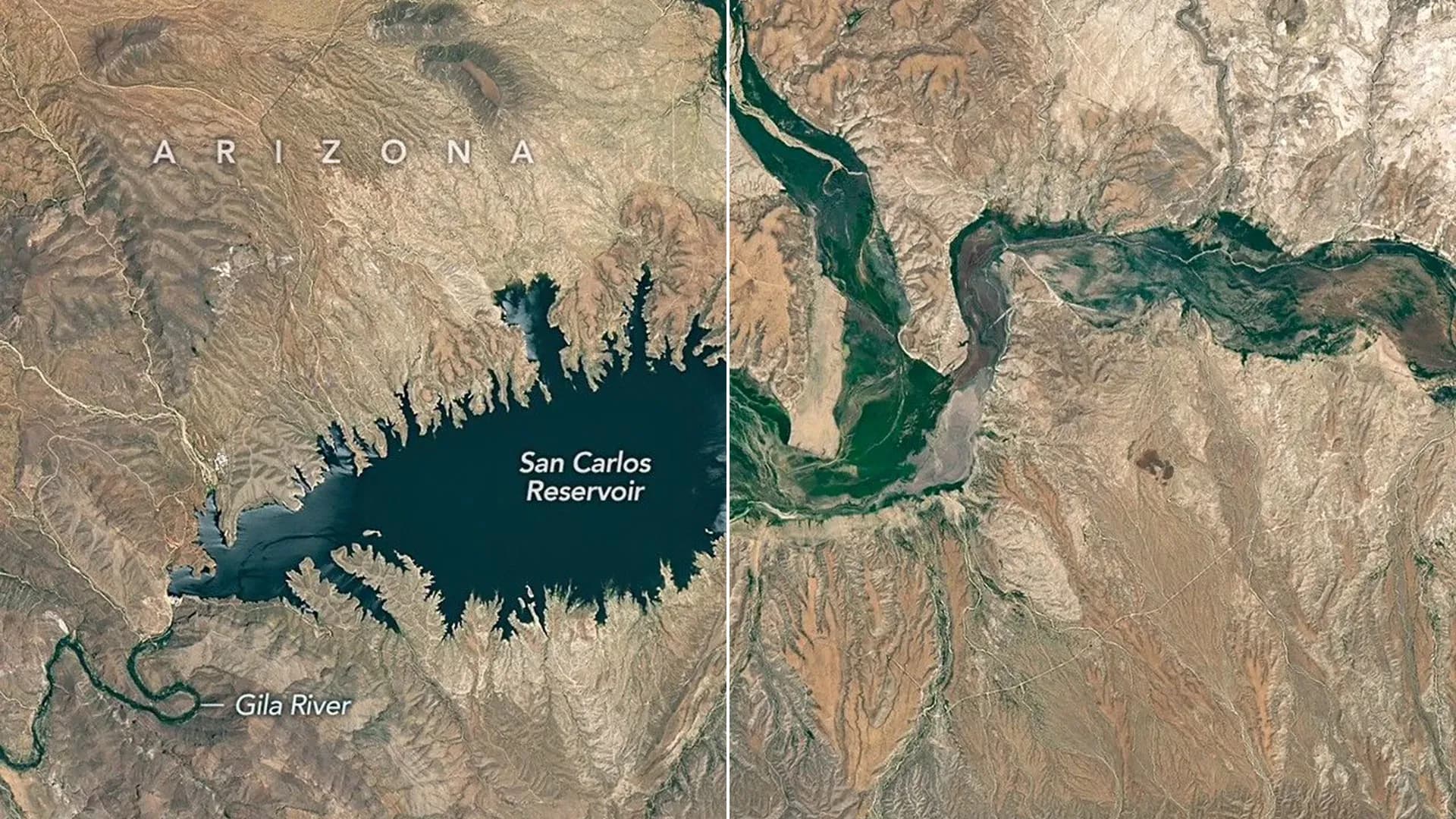
Satellite imagery captured by Landsat made the scale of the crisis visually undeniable. A photograph taken on May 22, 2026, shows the reservoir holding just 389 acre-feet — less than 1% full. When compared with an image from June 2023, which shows the reservoir sitting at approximately 60% capacity, the transformation is dramatic. Vegetation now visible along the exposed shoreline and riverbed includes tamarisk, willow, cottonwood, sedges, and various grasses.
Oxygen Crash Triggers Massive Fish Kill
As water levels plummeted, dissolved oxygen concentrations within the reservoir fell sharply. The resulting hypoxic conditions proved lethal, killing off virtually the entire fish population.
Authorities officially closed the reservoir on June 5, 2026. The die-off impacted a wide range of species, including largemouth bass, black crappie, bluegill, channel catfish, and flathead catfish, as well as stocked varieties such as brown trout and rainbow trout.
The San Carlos Recreation and Wildlife Department issued a public health warning alongside the closure announcement, cautioning that decomposing fish carcasses pose serious health risks to anyone attempting to fish or navigate the area by boat.
Not the First Time — But Still Severe
As catastrophic as the current situation appears, it is not without historical precedent. Records indicate that San Carlos Reservoir has run completely dry on at least 20 separate occasions since it first filled in 1930.
Even at the original dedication ceremony for the Coolidge Dam, conditions were dry enough that grass had begun growing across the exposed lakebed. Humorist Will Rogers famously quipped to President Calvin Coolidge: "If that was my lake, I'd mow it."
Major fish kills have struck the reservoir before as well. A 1976 event claimed more than 5 million fish, and the ecosystem reportedly took five full years to recover. A more recent kill occurred in 2018, underscoring the reservoir's ongoing vulnerability to drought conditions.
Drought Persists, But Summer Rains Offer Hope
The broader region remains gripped by a multi-year drought. Data from the U.S. Drought Monitor confirms that much of the Gila River's headwater region in New Mexico is currently experiencing severe drought conditions.
Nevertheless, the Gila River's flow is known to fluctuate dramatically from one year to the next, and a robust monsoon season could meaningfully restore the reservoir's water levels.
A NOAA seasonal outlook released in May 2026 estimated a 33 to 50% probability of above-average rainfall across the region during the summer months. Adding to that cautious optimism, strengthening El Niño conditions in the central and eastern equatorial Pacific — observed during late spring 2026 — are associated with an increased likelihood of heavy rainfall across the southwestern United States.
Whether those rains arrive in sufficient quantities to reverse the damage remains to be seen, but scientists and water managers will be watching the skies closely in the months ahead.

