Anonymous Afghan Cousins Use Photography to Expose the Hidden Lives of Women Under Taliban Rule
Two anonymous Afghan cousins are using black-and-white photography to document the harsh realities and quiet dreams of women living under Taliban oppression.

Anonymous Afghan Cousins Use Photography to Expose the Hidden Lives of Women Under Taliban Rule
A series of striking black-and-white photographs — created by two anonymous Afghan cousins living under Taliban rule — is currently captivating audiences at the Photoville Festival in Brooklyn, New York. The images blend raw documentary reality with poetic symbolism, offering a rare and deeply personal window into the lives of Afghan women today.
Art Born From Silence and Survival
The photographers, who use the pseudonyms Mahnaz Ebrahimi (born in 2000) and Somayeh Ebrahimi (born in 2001), are cousins from a remote mountain farming village in Afghanistan. They have deliberately chosen to remain anonymous, fearing violent retaliation from Taliban authorities for their artistic work. Both belong to the Hazara ethnic group and practice Shia Islam — a community historically targeted for persecution under the Taliban's ultra-conservative Sunni governance.
Before the Taliban's return to power in 2021, their families had lived and worked as carpet weavers in Kabul. Following the regime change, they fled the capital in search of safety, eventually settling in the isolated rural community where they now create their thought-provoking images.
Neither woman had any formal photography training. They began capturing images on their cellphones around 2022, gradually developing a distinctive visual language that merges their difficult surroundings with messages that are by turns lyrical, political, and deeply human.
Discovered on Instagram, Brought to the World Stage
Madrid-based curator and gallery director Edith Arance first discovered the cousins' work on Instagram. Immediately drawn to the powerful way they wove together their stark environment and profound themes, she reached out — aided by her basic knowledge of Farsi, the Persian language.
"I know a little Farsi, so I could approach them," Arance explains. The collaboration unfolded entirely through Instagram. In November 2024, Arance featured their photographs at her Madrid gallery, Galería Sura, which focuses on emerging photographers from Southwest Asia and Africa.
The exhibition has since traveled to New York, where it remains on display at the Photoville Festival through May 30. Arance describes the body of work using the literary term auto-fiction — a genre that weaves together autobiography and imagination. While the photographs are grounded in the very real landscape of the cousins' daily lives, the poses, gestures, and symbolic elements introduce an interior world of longing, resistance, and hope.
Images That Speak Louder Than Words
Several photographs in the series have drawn particular attention for their evocative power.
In It Will Not Stand in My Way, a woman dressed in a full burka rides a bicycle, her hands firmly gripping the handlebars. The mesh veil across her eyes limits her vision, yet the image radiates unmistakable determination. The title says everything.
Another image shows a similarly veiled figure spinning with such force that her flowing garments appear to lift her off the ground like a bird taking flight. Written in Farsi on the brick wall behind her is the phrase: "I dreamed that my homeland was prosperous."
"Courage means being afraid and trembling in the face of adversity, but with the courage, dance!" says photographer Somayeh Ebrahimi of the image.
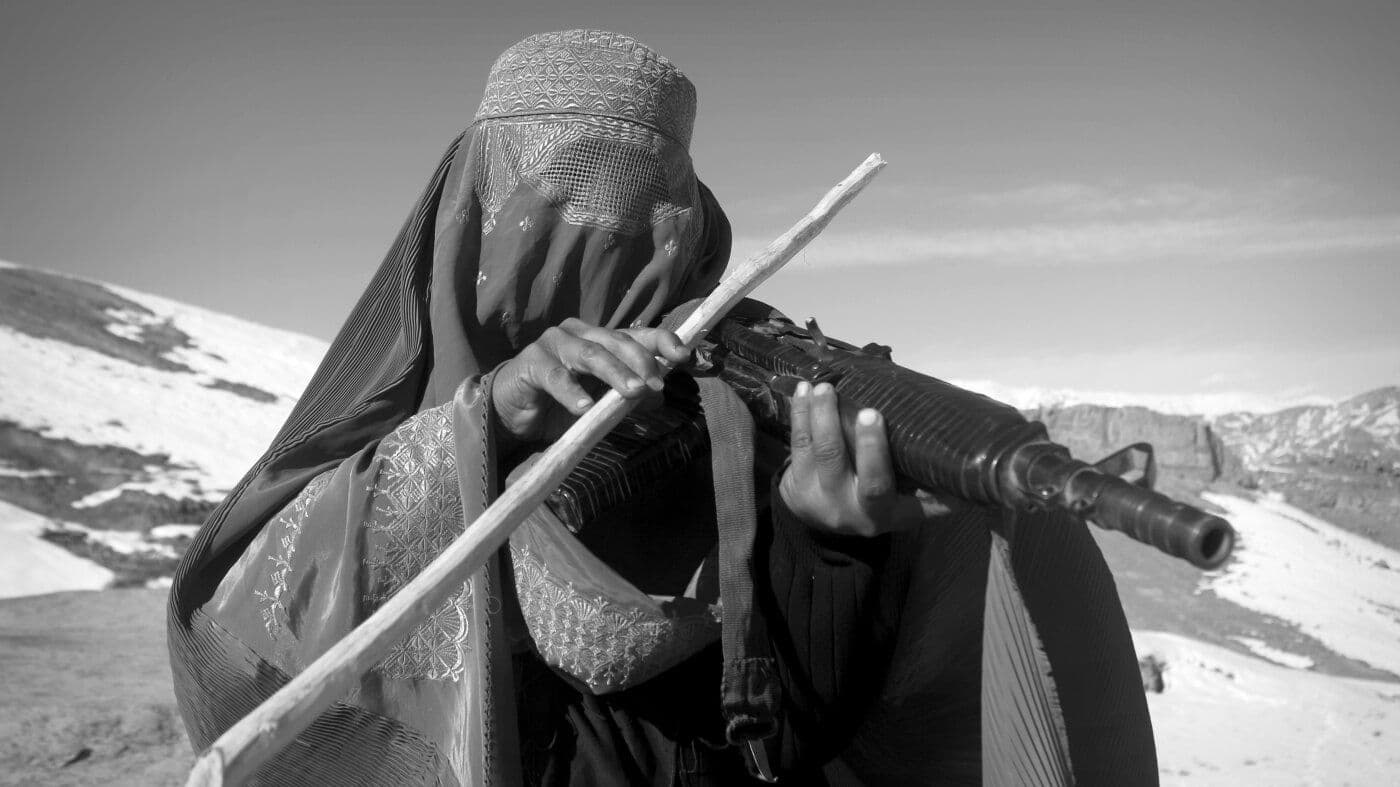
A third photograph, titled The Music of Poverty and Violence, depicts a burka-clad woman resting an automatic rifle on her shoulder as though it were a violin, drawing a long wooden stick across it as if playing music — a haunting metaphor for a life shaped by armed conflict and deprivation.
Symbolism, Magic Realism, and the Language of Light
Arance draws comparisons between the cousins' visual approach and the literary tradition of magic realism. Their deliberate use of light and shadow, combined with recurring natural symbols — trees, leaves, plants, and butterflies — creates an atmosphere where the physical and the metaphorical coexist.
In Life Is Today, a young girl dances freely on a bare ridge overlooking snow-covered mountains — no veil, no burka, just a child in motion. "Her shadow looks like an airplane flying away," Arance observes. The image, the photographers explain, is a call to embrace the present moment when the future feels uncertain.
Liberation captures a woman, her back to the camera, flinging her burka upward into the sky. Her hair, adorned with decorations forbidden under Taliban law, is fully visible. The accompanying poem by Mahnaz Ebrahimi reads: "In the name of being a woman, today I will free myself from oppression and darkness to the breeze, to the height of the sky."
Girl by the Door is perhaps the most symbolically dense of the series. A young girl clutches a worn schoolbook while standing half-concealed behind a pale wooden door reinforced with chains. Half her face is lit; the other half disappears into shadow. Mahnaz's caption explains: "Light, knowledge, life resides outside. Darkness is the interior of the domestic space to which girls and women are relegated" — a direct reference to the Taliban's ban on female education beyond sixth grade.
Defiance in the Details
Other photographs address specific restrictions imposed on women and girls in Taliban-controlled Afghanistan. Vestiges of the Present features a woman in colorful clothing holding a silent boombox — a reminder that music, dancing, and singing are all prohibited for women in public spaces.
In another outdoor scene, a young girl is shown cowering under the aim of an unseen gunman's rifle, yet she refuses to release her grip on a school notebook bearing the Farsi inscription: "There is no justice."
Yet amid the darkness, threads of hope persist. From the Depths of Darkness shows a woman holding a small mound of earth and twigs in her outstretched hand, from which a butterfly is delicately emerging — a symbol of transformation and resilience.
Similarly, And the Glory of Growing Happens Within Us portrays a burka-covered woman cradling a living, blossoming plant in her hands — finding renewal and inspiration in something as quiet and unstoppable as new growth.
A Declaration Against a Predetermined Destiny
Taken together, the photographs deliver a unified and defiant message. As Arance articulates it: "The Taliban may say that this is the destiny of women in Afghanistan, but I'm saying this is not my destiny."
Through their camera lenses, two anonymous young women from a remote Afghan village are asserting something powerful and universal — that identity, imagination, and the will to dream cannot be legislated away. Their work stands not only as a document of hardship, but as a testament to the enduring human need for freedom, expression, and hope.