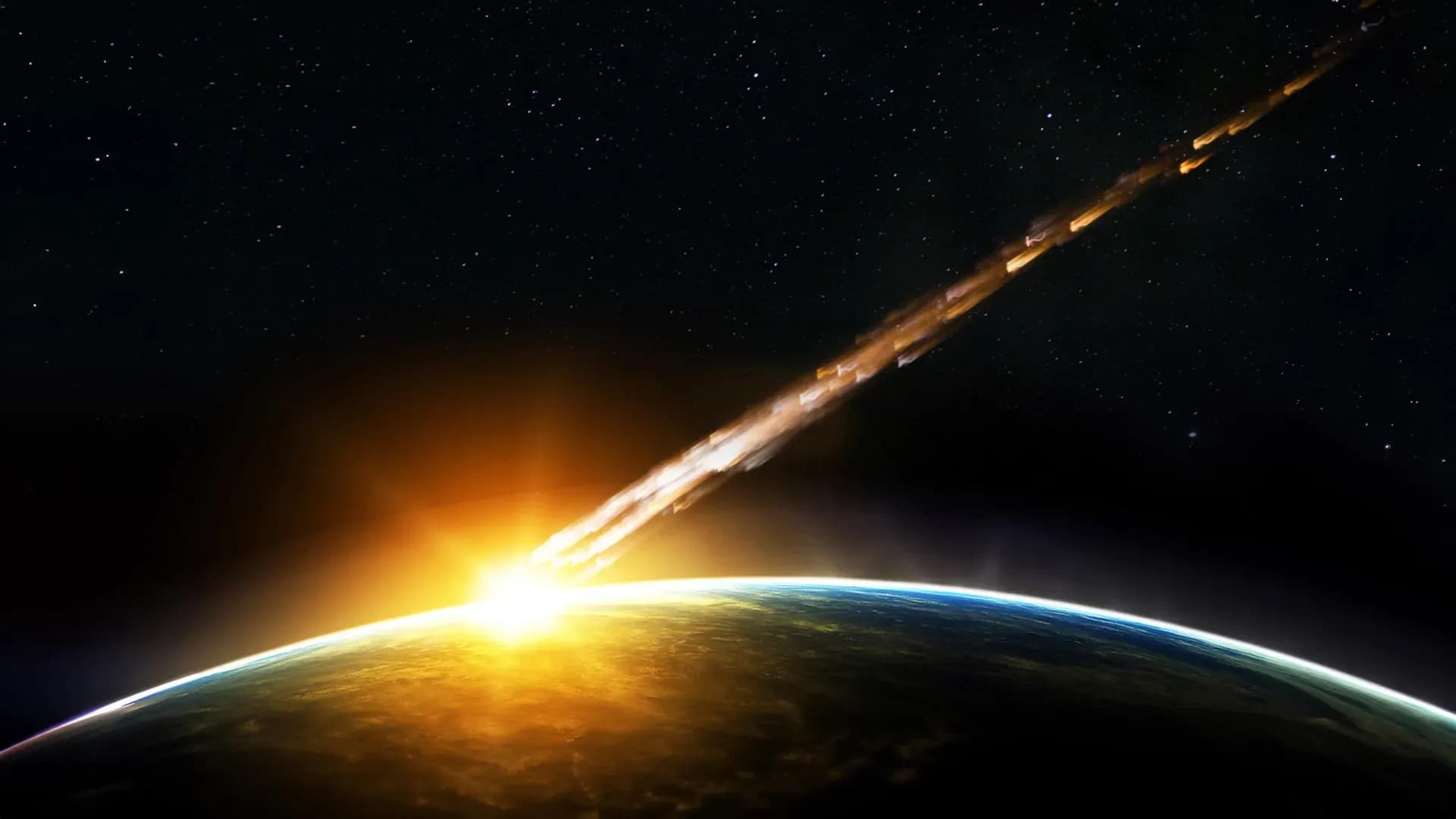
Ancient Asteroid Strike in the North Sea Unleashed a 330-Foot Tsunami, Scientists Confirm
A decades-long geological mystery has been solved. Scientists have confirmed that an asteroid struck the North Sea 43–46 million years ago, triggering a massive tsunami.

The North Sea's Hidden Crater Finally Has an Answer
For more than twenty years, a strange circular structure buried deep beneath the North Sea defied explanation. Scientists argued, debated, and even voted on its origins — and still couldn't agree. Now, a team of researchers has delivered a definitive verdict: the Silverpit Crater was carved out by an asteroid impact roughly 43 to 46 million years ago, and the collision was violent enough to send a wall of water more than 100 meters into the sky.
The findings, published in the journal Nature Communications, bring one of geology's most stubborn controversies to a close.
What Is the Silverpit Crater?
The Silverpit Crater sits approximately 700 meters below the floor of the southern North Sea, around 80 miles off the Yorkshire coastline. First identified in 2002, the structure spans about three kilometers across and is encircled by a sprawling network of circular fault rings stretching nearly 20 kilometers in diameter.
Faults — fractures in the Earth's crust caused by displacement or stress — gave the crater an unusual appearance that immediately caught the attention of geologists. Its circular form, central peak, and radiating fault pattern bore a striking resemblance to confirmed impact sites found elsewhere on the planet.
Yet not everyone was convinced. Some experts argued the feature was the result of shifting underground salt deposits, while others pointed to volcanic collapse as a possible explanation. The debate grew so heated that geologists formally voted on the crater's origins in 2009. At the time, the majority rejected the asteroid impact theory.
New Evidence Overturns Two Decades of Doubt
The research team, led by Dr. Uisdean Nicholson of Heriot-Watt University in Edinburgh and supported by the Natural Environment Research Council (NERC), approached the problem with a powerful combination of tools: advanced seismic imaging, microscopic rock analysis, and computer-generated impact simulations.
Seismic imaging — which functions much like an ultrasound scan applied to the Earth's crust — gave scientists an extraordinarily detailed view of the crater's underground structure. But the most compelling proof came from something far smaller.
Rock samples recovered from a nearby oil exploration well contained what geologists call shocked quartz and feldspar crystals — minerals that bear unmistakable microscopic patterns formed only under extreme pressure. The kind of pressure that only a hypervelocity impact can generate.
The 'Needle-in-a-Haystack' Discovery
Dr. Nicholson described the find as a fortunate breakthrough:
"New seismic imaging has given us an unprecedented look at the crater. Samples from an oil well in the area also revealed rare 'shocked' quartz and feldspar crystals at the same depth as the crater floor. We were exceptionally lucky to find these — a real needle-in-a-haystack effort. These prove the impact crater hypothesis beyond doubt, because they have a fabric that can only be created by extreme shock pressures."
Shocked minerals are widely regarded as one of the gold standards for confirming asteroid impacts. No ordinary geological process — not volcanic activity, not salt tectonics — can replicate the pressures required to alter these crystals at a microscopic level.
A 160-Meter Space Rock and a Catastrophic Wave
According to the research team's reconstruction, the object responsible was an asteroid approximately 160 meters (525 feet) wide. It struck the ancient seabed at a shallow angle, approaching from the west at tremendous speed.
The consequences were instantaneous and catastrophic.
"Within minutes, it created a 1.5-kilometer-high curtain of rock and water that then collapsed into the sea, creating a tsunami over 100 meters high," said Dr. Nicholson.
To put that in perspective, a 100-meter tsunami stands taller than 330 feet — surpassing the height of many modern skyscrapers. The impact would have blasted enormous quantities of rock, sediment, and seawater high into the atmosphere before the debris collapsed back down and triggered the towering wave.
While small in comparison to the roughly 10-kilometer asteroid thought to have ended the age of the dinosaurs, a 160-meter impactor still carries enough energy to cause regional devastation on a massive scale.
The Simulation That Sealed the Case
Professor Gareth Collins of Imperial College London, who also participated in the original 2009 debate, developed the numerical models used to simulate the impact. His simulations allowed the team to compare the theoretical effects of such a collision against the actual structure observed beneath the seafloor — and the match was conclusive.
"I always thought that the impact hypothesis was the simplest explanation and most consistent with the observations. It is very rewarding to have finally found the silver bullet. We can now get on with the exciting job of using the amazing new data to learn more about how impacts shape planets below the surface."
Why So Few Impact Craters Survive on Earth
Despite Earth's long history of being struck by asteroids and comets, relatively few impact craters are still identifiable today. The planet's surface is in a constant state of renewal — shaped and reshaped by erosion, weathering, volcanic eruptions, and the gradual movement of tectonic plates. Over millions of years, these forces quietly erase the evidence of ancient collisions.
The preservation of the Silverpit Crater beneath the North Sea, shielded by layers of sediment, is part of what made it such a scientifically valuable — and endlessly debated — discovery.
With the mystery now resolved, researchers say the real scientific work is just beginning. The crater offers a rare window into how high-velocity impacts deform the Earth's crust, providing clues that could help scientists better understand planetary geology far beyond our own world.