Amateur Butterfly Hunter's UV Torch Discovery Sparks Nationwide Conservation Breakthrough
A Surrey hobbyist stumbled upon one of Britain's rarest butterflies during a lockdown walk — and his ingenious method for finding them is now changing conservation science.

How One Man's Lockdown Discovery Changed Butterfly Conservation Forever
What began as a casual stroll through the Surrey countryside during the COVID-19 lockdown has evolved into a landmark moment for butterfly conservation in the United Kingdom. Gareth Tilley, an amateur lepidopterist from Epsom, made history when he became the first person ever to record the black hairstreak butterfly in Surrey — a discovery that has since triggered a revolutionary new approach to monitoring this elusive species.
A Once-in-a-Lifetime Sighting
In 2020, with daily routines disrupted by lockdown restrictions, Tilley began exploring the green spaces near his Epsom home. During one of these walks, something extraordinary happened.
"During one of those walks a butterfly landed in front of me," Tilley recalled. "I was amazed to see it was a black hairstreak."
The sighting was significant for one compelling reason: prior to this moment, the black hairstreak had only ever been documented in woodland corridors stretching between Oxford and Peterborough. Surrey was entirely off the map for this species.
Unsurprisingly, not everyone was convinced. When Tilley shared his discovery with locals, some dismissed it as a one-off illegal release rather than a naturally occurring population.
Confirming the Impossible
Determined to validate his finding, Tilley collaborated with Butterfly Conservation, the local council, and the University of Sussex. Together, they gathered the evidence needed to confirm that a genuine black hairstreak population does indeed exist in Surrey.
This was no small feat. The black hairstreak is considered one of Britain's most challenging butterflies to study. Its caterpillars are masterfully camouflaged to resemble leaves, the chrysalis mimics bird droppings, and adult butterflies spend much of their time concealed high in the tree canopy.
"The species is notoriously difficult to monitor," Tilley explained.
According to Butterfly Conservation, the black hairstreak's UK distribution has contracted by 33% since 2002, a decline driven primarily by widespread habitat loss.
The UV Torch That Changed Everything
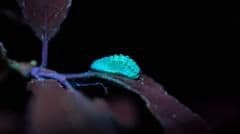
The most transformative chapter of Tilley's journey came after he learned that certain caterpillar species in the United States fluoresce under ultraviolet light. Intrigued by the possibility, he purchased a UV torch and put the theory to the test in May 2022.
He admitted to being doubtful at first. "I was sceptical it would work," he said.
His scepticism quickly dissolved.
"But when I found a caterpillar, it didn't just glow — it was incredibly bright."
In a single evening, Tilley located 46 black hairstreak caterpillars using this technique — a number that would have been virtually impossible to achieve through conventional survey methods.
Why Do the Caterpillars Glow?
The biological purpose behind the caterpillars' UV fluorescence remains a mystery to scientists. Tilley has suggested the glow may serve as a predator deterrent, though it is also possible the trait has no direct survival function at all. Further research will be needed to answer this question definitively.
A New Era for Butterfly Surveying
Butterfly Conservation has formally acknowledged the significance of Tilley's methodology and is now actively promoting UV-based surveying for hairstreak species across the entire country.
Steven Lofting, the charity's South East Conservation Manager, praised Tilley's contribution in the strongest terms.
"Tilley's work has made a hugely valuable contribution to butterfly conservation in the UK," Lofting said. "We are finding much higher numbers of hairstreaks using UV surveys, and it's a new, fun way to engage volunteers."
The impact of this discovery is already reaching beyond British shores. Tilley is actively sharing the UV surveying technique with conservation organisations in Australia, demonstrating just how far one man's lockdown curiosity can travel.
A Blueprint for Citizen Science
Gareth Tilley's story is a powerful reminder of what passionate individuals can contribute to scientific understanding. Armed with little more than a UV torch and an eye for detail, he not only uncovered a hidden population of one of Britain's rarest butterflies but also gifted conservationists a practical new tool to protect them for generations to come.