AI Body-Mapping Tool Exposes Obesity's Surprising Damage to Facial Nerves
A groundbreaking AI system has mapped an entire mouse body at cellular resolution — revealing that obesity silently destroys facial sensory nerves.
AI-Powered Body Scanner Uncovers a Hidden Consequence of Obesity
Scientists have long known that obesity does far more than add inches to a waistline. It disrupts hormones, strains the heart, and increases the risk of diabetes and cancer. But a remarkable new artificial intelligence platform has now uncovered something that researchers had never seen before: obesity quietly destroys sensory nerves in the face — and the same molecular fingerprint appears in human tissue.
The discovery came from a team of researchers at Helmholtz Munich, Ludwig Maximilians University Munich (LMU), and several collaborating institutions. Their findings were published in the prestigious journal Nature.
Introducing MouseMapper: A Whole-Body Disease Scanner
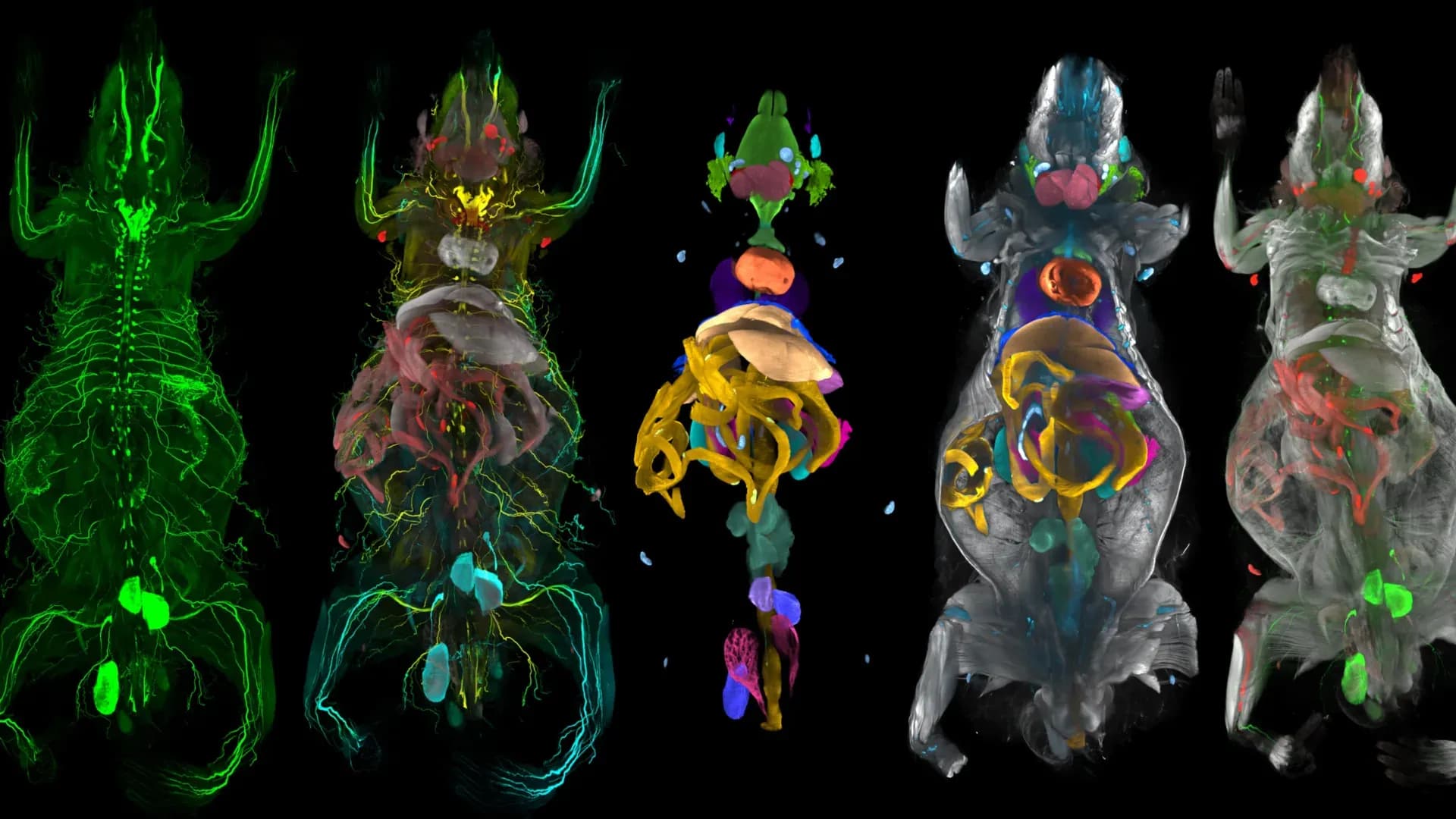
At the heart of this research is a newly developed AI framework called MouseMapper. Unlike traditional imaging approaches that examine one organ or tissue at a time, MouseMapper analyzes entire mouse bodies at cellular-level resolution — all at once.
The system is built on foundation-model-based deep learning algorithms capable of processing enormous datasets generated from whole-body imaging. It can automatically identify and segment 31 distinct organs and tissue types, while simultaneously mapping nerve networks and immune cell distributions throughout the body.
"MouseMapper is built on a foundation model, which means it generalizes far beyond the data it was originally trained on," explained Ying Chen, co-first author of the study.
How the Imaging Process Works
Creating these full-body maps required a sophisticated multi-step process:
- Fluorescent tagging: Researchers labeled nerves and immune cells with fluorescent markers visible under a microscope.
- Tissue clearing: Mice were rendered optically transparent using specialized clearing techniques, preserving fluorescent signals without physically sectioning the tissue.
- Light-sheet microscopy: High-powered 3D imaging captured tens of millions of cellular structures across every region of the body.
- AI analysis: MouseMapper then automatically identified anatomical zones, nerve pathways, and immune cell clusters from the resulting datasets.
This end-to-end pipeline eliminated the need for scientists to pre-select specific regions of interest — allowing truly unbiased, body-wide discovery.
Obesity Triggers Inflammation and Destroys Facial Nerve Branches
To study obesity's effects, researchers fed mice a high-fat diet that produced metabolic changes closely mirroring those seen in people with obesity. When MouseMapper analyzed the results, it revealed sweeping changes in immune cell organization and nerve architecture across multiple organ systems — including fat tissue, muscle, and the liver.
The most unexpected finding, however, involved the trigeminal nerve — a major facial nerve responsible for sensation and certain motor functions in the face.
In obese mice, this nerve showed a dramatic reduction in branches and nerve endings, pointing to significant impairment of sensory function. Behavioral testing confirmed the damage: obese mice responded far less to sensory stimulation than their lean counterparts.
The Molecular Evidence — and Its Human Connection
The team then examined the trigeminal ganglion, the structure housing the cell bodies of facial sensory neurons. Using spatial proteomics analysis, they identified distinct molecular changes associated with inflammation and nerve remodeling.
Critically, the same molecular signatures were discovered in trigeminal tissue samples taken from humans living with obesity — suggesting this nerve damage is not limited to animal models.
"We revealed previously unknown structural and molecular changes in the trigeminal ganglion and its facial branches, and the same molecular signature was conserved in human tissue. This kind of finding simply cannot emerge from studying one organ at a time," said Dr. Doris Kaltenecker, senior scientist at Helmholtz Munich's Institute for Diabetes and Cancer and first author of the study.
A Platform Built for Complex, Multi-System Diseases
The researchers believe MouseMapper's potential extends well beyond obesity research. Because many serious conditions — including diabetes, cancer, neurodegenerative diseases, and autoimmune disorders — affect multiple organ systems simultaneously, a whole-body analysis framework could transform how scientists study and understand them.
The team has made their complete whole-body imaging datasets publicly available, enabling researchers worldwide to explore obesity-related biological changes across organs and tissues independently.
The Vision: Digital Twins of Disease
Looking further ahead, Prof. Ali Ertürk, Director of the Institute for Biological Intelligence at Helmholtz Munich and lead researcher on the project, outlined an ambitious long-term goal.
"Our goal is to create a comprehensive framework for understanding how diseases affect the body as an interconnected system," said Ertürk. "Our long-term vision is to build truly realistic digital twins of mice in health and disease: cell-level atlases that we can query, perturb, and screen computationally. That would let us pinpoint the earliest changes a disease causes, design interventions to prevent them, and accelerate the discovery of new treatments while reducing the number of physical experiments we need to run."
In other words, MouseMapper may one day help scientists fight disease before it ever takes hold — guided by a complete, living map of the body at the cellular level.