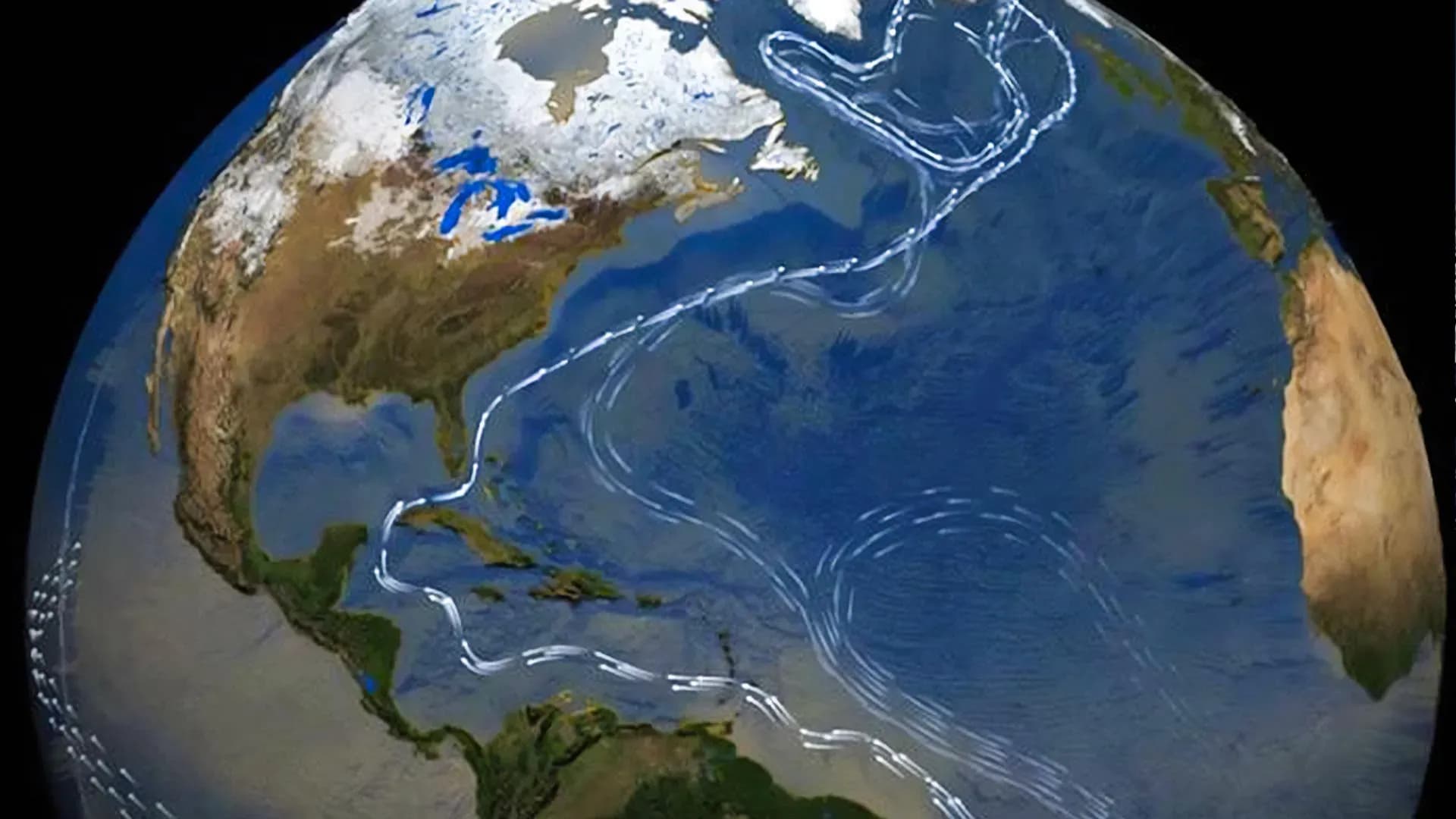
A Vital Atlantic Ocean Current Is Losing Strength — And the Consequences Could Be Global
New research confirms the AMOC has been weakening for nearly two decades. Here's what that means for weather, sea levels, and life on both sides of the Atlantic.

A Major Ocean Current Is Quietly Fading — And Scientists Are Alarmed
Deep beneath the surface of the Atlantic Ocean, one of Earth's most powerful climate engines is losing momentum. Researchers have gathered compelling evidence that the Atlantic Meridional Overturning Circulation — commonly known as the AMOC — has been steadily weakening for close to two decades. The implications of this slowdown could ripple across continents, reshaping weather patterns, altering coastlines, and disrupting the seasons millions of people depend on.
What Is the AMOC and Why Does It Matter?
The AMOC functions like a massive conveyor belt, continuously moving warm surface water northward through the Atlantic while pushing cooler, denser water back toward the south along the ocean floor. This circulation plays a fundamental role in regulating temperatures across the Northern Hemisphere, influencing everything from European winters to hurricane behavior and rainfall distribution in tropical regions.
When this system operates at full strength, it acts as a stabilizing force for global climate. When it falters, the consequences can be far-reaching and difficult to reverse.
What the New Research Found
The study, led by scientists at the University of Miami Rosenstiel School of Marine, Atmospheric and Earth Science, represents some of the most direct observational evidence yet that the AMOC is in decline. Researchers analyzed nearly 20 years of continuous data collected from four ocean monitoring arrays placed along the western edge of the North Atlantic, spanning latitudes from approximately 16.5°N to 42.5°N — a stretch that runs from tropical waters up through mid-latitude regions.
How Scientists Measured the Change
The monitoring equipment consists of instruments anchored directly to the seafloor, designed to measure pressure, temperature, water density, and current movement over extended periods. By tracking shifts in bottom pressure, the research team was able to estimate deep ocean flow at depths exceeding 1,000 meters.
Applying a consistent methodology across all four monitoring sites allowed the scientists to identify a clear and sustained decline in the deep-water circulation along the ocean's western boundary. Because the weakening trend appeared uniformly across such a broad geographic range, researchers concluded this is not a short-term fluctuation but rather a meaningful, large-scale transformation.
The findings were published in the journal Science Advances under the title "Meridionally consistent decline in the observed western boundary contribution to the Atlantic Meridional Overturning Circulation."
What a Weaker AMOC Could Mean for the World
The potential consequences of continued AMOC weakening are wide-ranging and serious. According to Shane Elipot, a physical oceanographer and senior author of the study, a diminished circulation system could trigger significant shifts in global weather behavior.
"A weaker AMOC can shift weather patterns, potentially leading to more extreme storms, changes in rainfall, or colder winters in some regions," Elipot explained. "It can also influence sea-level rise along coastlines, affecting communities and infrastructure."
Among the most frequently cited concerns are:
- Harsher winters across Europe, as the current delivers warmth that moderates the continent's climate
- Elevated sea levels along North American coastlines, particularly in densely populated areas
- Disrupted rainfall patterns across tropical and subtropical regions
- Increased hurricane activity or shifts in storm tracks across the Atlantic basin
An Early Warning System for Climate Change
Beyond the findings themselves, researchers believe the monitoring network used in this study could serve a broader purpose. Elipot and his colleagues suggest that measurements taken along the western boundary of the Atlantic may function as an early detection system for long-term climate disruption — comparable, they say, to a canary in a coal mine.
By continuously tracking changes in deep ocean circulation, scientists hope to provide policymakers, urban planners, and emergency managers with the advanced warning needed to prepare for shifting environmental conditions.
"This research helps scientists better predict how the climate may change in the coming decades — information that governments, businesses, and communities use to prepare for future environmental conditions," said Elipot.
Looking Ahead
The research team hopes their findings will be used to refine existing climate models, improving the accuracy of long-range forecasts and deepening the scientific community's understanding of how human-driven climate change is reshaping one of the planet's most critical natural systems.
The study received funding support from the U.S. National Science Foundation and the UK Natural Environment Research Council, reflecting the international urgency surrounding AMOC research.
As the data continues to accumulate and the trend becomes harder to ignore, one message is increasingly clear: the ocean's quiet machinery is changing, and the world above the surface will eventually feel every shift.

