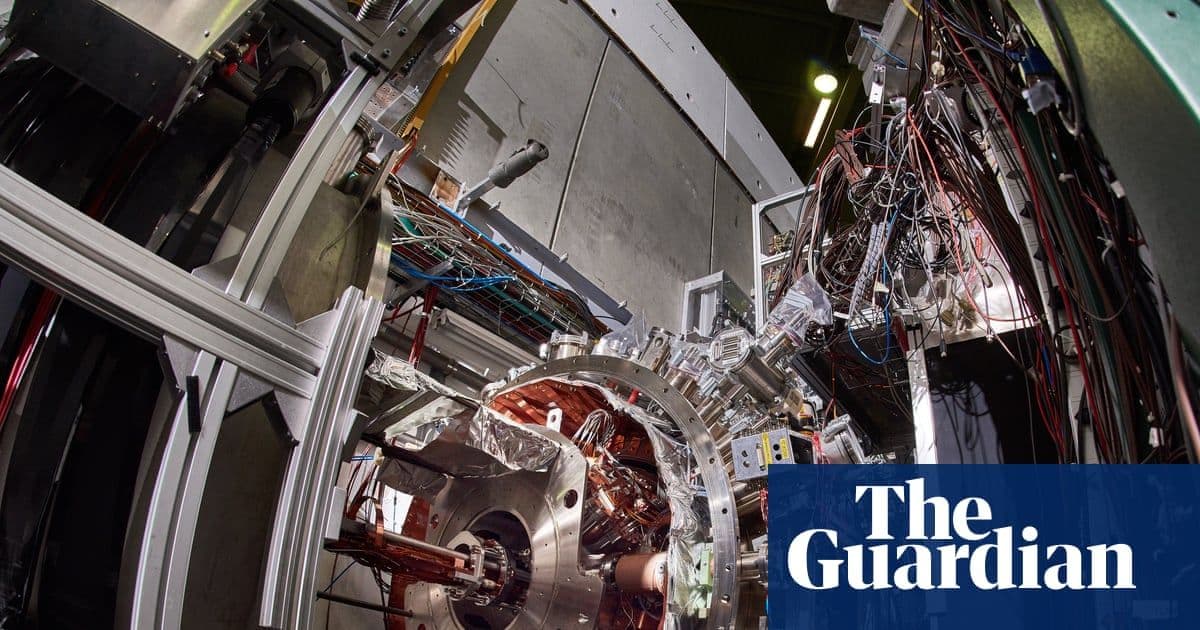
A Historic First: Scientists Prepare to Transport Antimatter Across the Road
For the first time in history, researchers at CERN are preparing to move antimatter — one of the universe's most volatile substances — in a groundbreaking transport test.
A Groundbreaking Journey Begins at CERN
Somewhere on the sprawling campus of CERN, the European Organization for Nuclear Research situated near Geneva, Switzerland, a truck is getting ready to make history. Its cargo? A one-tonne containment device holding one of the rarest and most extraordinary substances ever created by human hands — antimatter.
The planned 20-minute drive around the facility grounds represents what scientists believe will be the world's very first attempt to physically transport antimatter from one location to another. When matter and antimatter collide, both are annihilated instantly in a flash of pure energy — making this no ordinary cargo run.
Years of Preparation for a 20-Minute Drive
Reaching this milestone has been the result of years of meticulous research and engineering. Should the test prove successful — meaning the truck completes its short circuit and returns with the antimatter still safely contained — it would open the door for CERN to eventually ship antimatter to research facilities around the world.
In those external laboratories, scientists would be able to conduct far more precise measurements than are currently possible at CERN itself. These measurements could hold the key to one of science's most enduring mysteries: why does the universe consist almost entirely of matter, and not antimatter?
"A core question we want to understand is where did matter come from. And then, if you know about antimatter, it's natural to ask, why is that not here? The process is not understood and we are hunting for clues as to why it happened," explains Dr. Christian Smorra, a physicist working on the Baryon Antibaryon Symmetry Experiment, known as BASE, at CERN.
What Exactly Is Antimatter?
The name itself conjures images of science fiction — and indeed, antimatter has long captured the imagination of storytellers. In the Star Trek universe, it powers the Enterprise's warp drives and photon torpedoes. In Dan Brown's thriller Angels and Demons, a tiny canister of stolen antimatter threatens to level Vatican City.
In reality, the science is far less dramatic — and more fascinating. Antimatter particles are, in essence, mirror-image counterparts to ordinary matter particles. They share the same mass but carry an opposite electrical charge. Interestingly, everyday items like bananas naturally emit antiparticles through the radioactive decay of potassium, though in quantities far too small to be of any scientific use.
The antimatter aboard CERN's transport device will consist of approximately 1,000 antiparticles, collectively weighing around one billionth of one trillionth of a gram. If containment were to fail entirely, the energy released upon contact with ordinary matter would be so negligibly small that the shipment doesn't even meet the threshold for a radioactive materials warning label.
A Discovery Rooted in Nobel Prize-Winning Physics
The theoretical foundation for antimatter was laid in 1928 by British physicist Paul Dirac, who combined quantum mechanics with Einstein's special theory of relativity. His equations predicted that every particle must have a corresponding antiparticle — an insight that earned him the Nobel Prize in Physics.
Just four years later, Carl Anderson at the California Institute of Technology made the first direct observation of antimatter, detecting a positron — the antimatter counterpart of an electron — streaking through a particle detector exposed to cosmic rays. He, too, received a Nobel Prize for the discovery.
Since then, scientists have confirmed the existence of a full range of antiparticles. Antimatter versions of electrons, protons, and neutrons can even combine to form anti-atoms and anti-molecules. Theoretically, entire anti-worlds built from antimatter could exist — completely indistinguishable in behavior from their matter-based equivalents.
"If we were all made of antimatter and lived in a universe made entirely of antimatter, we wouldn't notice any difference," says Dr. Jack Devlin, a Royal Society university research fellow at Imperial College London. "What's strange is that somehow the laws of physics allow the existence of this stuff that seems to behave in the same way as normal matter."
The Universe's Greatest Unsolved Mystery
According to the prevailing models of cosmology, the Big Bang should have produced equal quantities of matter and antimatter. Yet, when these two substances meet, they annihilate each other completely, converting into pure energy. So why didn't the entire universe reduce itself to a vast sea of energy?
"We seem to have ended up in a universe which is completely overwhelmed with regular matter and has almost no antimatter in it at all, and that is the heart of the mystery," says Devlin.
Scientists believe that subtle, yet detectable differences between matter and antimatter could explain how matter ultimately came to dominate. Uncovering those differences, however, requires incredibly precise experimental measurements — and a consistent, transportable supply of antimatter.
Inside CERN's Antimatter Factory
That supply comes from CERN's aptly named Antimatter Factory. Inside this facility, high-energy protons — the nuclei of hydrogen atoms — are fired at a dense metal target at tremendous speed. The resulting collisions produce showers of secondary particles, among which are antiprotons. These antiprotons are then guided into a specialized decelerator, slowed to roughly one-tenth the speed of light, and finally captured within an antimatter containment trap.
However, CERN's own facilities are not ideal for precision experimentation. The powerful electromagnetic fields generated by the decelerator interfere with sensitive measurements. Scientists estimate that other research institutions could carry out antimatter measurements with up to 100 times greater precision.
Engineering the World's Most Sensitive Delivery Vehicle
With this in mind, Dr. Smorra and his colleague Dr. Stefan Ulmer are developing a dedicated antimatter receiving facility at Heinrich Heine University in Düsseldorf, Germany. To survive the roughly 500-mile journey from Geneva to Düsseldorf, the antimatter would need to remain safely contained for more than 10 hours — including two hours for loading and unloading and the remainder for the road trip itself.
The containment device itself is an extraordinary feat of precision engineering. It must ensure that antiprotons never come into contact with any normal matter whatsoever. To achieve this, the inner chamber is maintained under ultra-high vacuum conditions comparable to the emptiness of deep interstellar space. The chamber is also cooled to an extreme -269°C, causing any stray gas molecules to freeze solid against the chamber walls before they can interfere with the contents.
Powerful magnetic and electric fields hold the antiprotons suspended at the very center of this cryogenic chamber, preventing them from drifting toward the walls. These fields are robust enough to keep the antimatter stable even if the truck encounters rough road surfaces, sharp braking, or sudden jolts.
Perhaps the most significant risk to the antimatter during transport isn't speed or turbulence — it's the possibility of a power failure caused by a traffic delay. For the initial test run at CERN, the containment device will be powered by onboard batteries capable of sustaining the system for approximately four hours. Any future long-distance transport will require a dedicated power generator installed on the vehicle.
A Milestone That Could Redefine Physics Research
"If we ever want to do experiments with antiprotons somewhere else, we need to get this on the road, and that's what we're trying to do," says Smorra. "First of all, we have to show we can move the antimatter, and this is the big milestone for us."
If the initial test drive succeeds, it won't just be a logistical achievement — it will mark the beginning of a new era in antimatter research. By making this extraordinary substance portable, scientists could unlock a deeper understanding of why our universe exists the way it does, and why matter — rather than its mysterious mirror image — became the building block of everything we know.