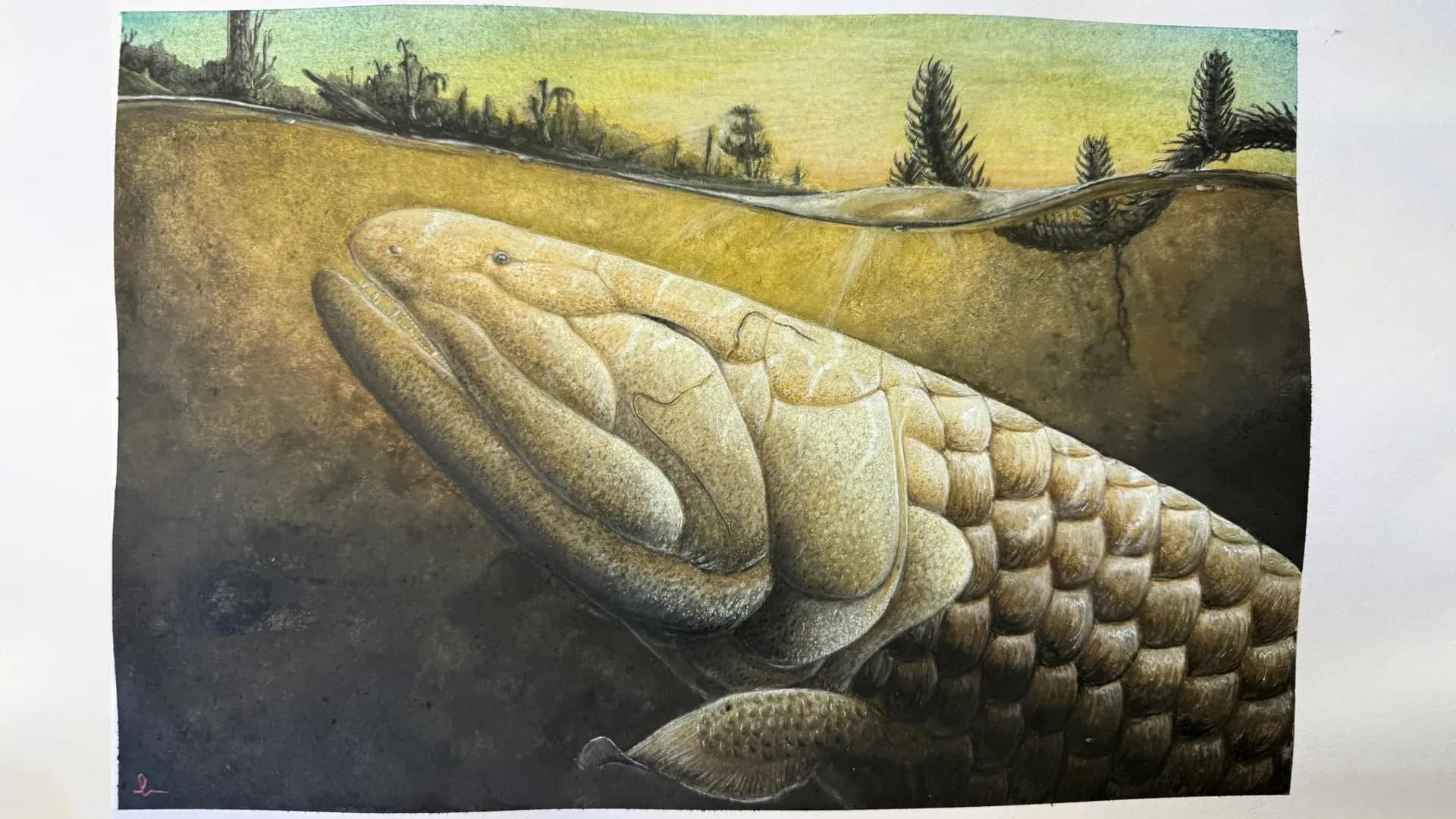
380-Million-Year-Old Antarctic Fish May Hold the Key to How Animals First Walked on Land
A prehistoric fish fossil from Antarctica is revealing remarkable clues about how aquatic life first made the leap onto dry land.

Ancient Fish Fossil Rewrites the Story of Life on Land
Deep within Antarctica's Lashly Mountains, scientists unearthed a fossil that may fundamentally reshape our understanding of one of evolution's most pivotal moments — the transition of vertebrate life from water to land. The specimen belongs to Koharalepis jarviki, a large predatory fish that swam Earth's ancient waters roughly 380 million years ago, and researchers at Flinders University have now used cutting-edge imaging technology to unlock secrets hidden inside its skull for hundreds of millions of years.
The findings, published in Frontiers in Ecology and Evolution, offer compelling new evidence about how early animals developed the biological tools necessary to survive beyond the water's edge.
What Makes This Fossil So Extraordinary
Koharalepis jarviki belonged to the Canowindrid family — a group of lobe-finned fish that once inhabited the ancient supercontinent of East Gondwana, with fossil evidence now spread across both Antarctica and Australia. Scientists regard these fish as close evolutionary cousins of the earliest four-limbed vertebrates, making every new discovery within this family scientifically priceless.
What sets this particular fossil apart is its remarkable preservation. According to PhD candidate and lead author Corinne Mensforth from the Flinders Palaeontology Lab, this is the only specimen within the entire Canowindrid family known to preserve the internal bones of the skull.
"We chose to focus on Koharalepis as it is the only fossil in the entire family to preserve the internal bones of the skull, which gives us valuable insights into its braincase and neuroanatomy," Mensforth explains.
High-Tech Imaging Reveals Hidden Anatomy
Rather than risk damaging the irreplaceable specimen through traditional excavation methods, researchers employed advanced neutron and synchrotron tomography — non-destructive scanning techniques capable of penetrating solid rock and revealing internal structures in extraordinary detail.
The scans produced surprising results. The brain of Koharalepis showed striking similarities to fish species already associated with the water-to-land evolutionary transition. Even more intriguing were two specific anatomical features that suggest this ancient predator was already adapting to life near the water's surface.
Researchers identified openings at the top of the skull that may have functioned as supplementary air intake channels, potentially allowing the fish to gulp atmospheric oxygen. They also detected a light-sensitive organ embedded within the brain — a structure linked to the detection of light and the regulation of circadian rhythms, essentially an ancient biological clock.
These adaptations point toward an animal that was spending significant time near the water's surface, possibly in shallow, oxygen-poor freshwater environments where the ability to breathe air would have been a decisive survival advantage.
Ancient Connections Between Australia and Antarctica
Flinders University Research Fellow Dr. Alice Clement, co-author of the study, emphasizes the broader significance of the Canowindrid family in understanding prehistoric geography as well as biology.
"This precious fossil belongs to a group called the Canowindridae, which highlights the ancient links between Australia and Antarctica," Dr. Clement notes. "It is important to study such specimens from the Devonian Age of Fishes when the waters teemed with predatory lobe-finned fish like this that are closely related to land animals."
A Fearsome Predator With Surprising Limitations
Beyond its evolutionary significance, the scans also revealed fascinating behavioral details about Koharalepis as a living animal. Stretching to approximately one meter in length, it was almost certainly an ambush predator, lurking in freshwater systems and striking at smaller prey with speed and precision.
However, the fish's relatively small eyes suggest that vision was not its primary hunting tool. Researchers believe it must have depended heavily on its other senses — possibly detecting vibrations or pressure changes in the water — to locate and capture prey effectively.
Decades of Discovery Come Full Circle
Flinders University Emeritus Professor John Long, who was part of the original research team that first formally described Koharalepis back in 1992, reflects on how far the science has come since that initial discovery.
"This has enabled us to understand some of the behavior, adaptations and relationships of Koharalepis to its environment and to the other tetrapod-like fishes — and how fish first left the water to live on land approximately 385 million years ago," Professor Long says.
The fact that modern imaging technology can reveal internal anatomy without physically disturbing a fossil has opened an entirely new chapter in paleontological research, allowing scientists to extract information that would have been unimaginable just a generation ago.
Another Piece in Evolution's Greatest Puzzle
The story of how vertebrates conquered dry land remains one of the most compelling narratives in the history of life on Earth. Each new fossil, each new scan, and each new anatomical detail brings scientists closer to understanding the precise biological and environmental pressures that drove ancient creatures to venture beyond the water.
Koharalepis jarviki adds another vital piece to that puzzle — a fish that was neither fully aquatic nor terrestrial, but something in between: a living experiment in adaptation, frozen in stone for nearly four hundred million years, waiting to tell its story.